Description
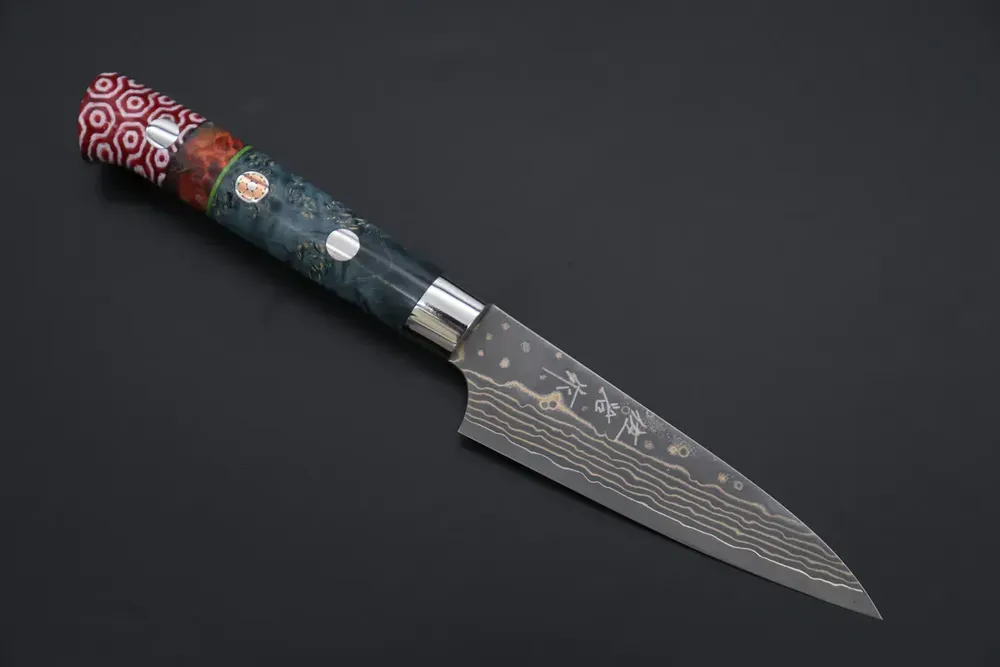
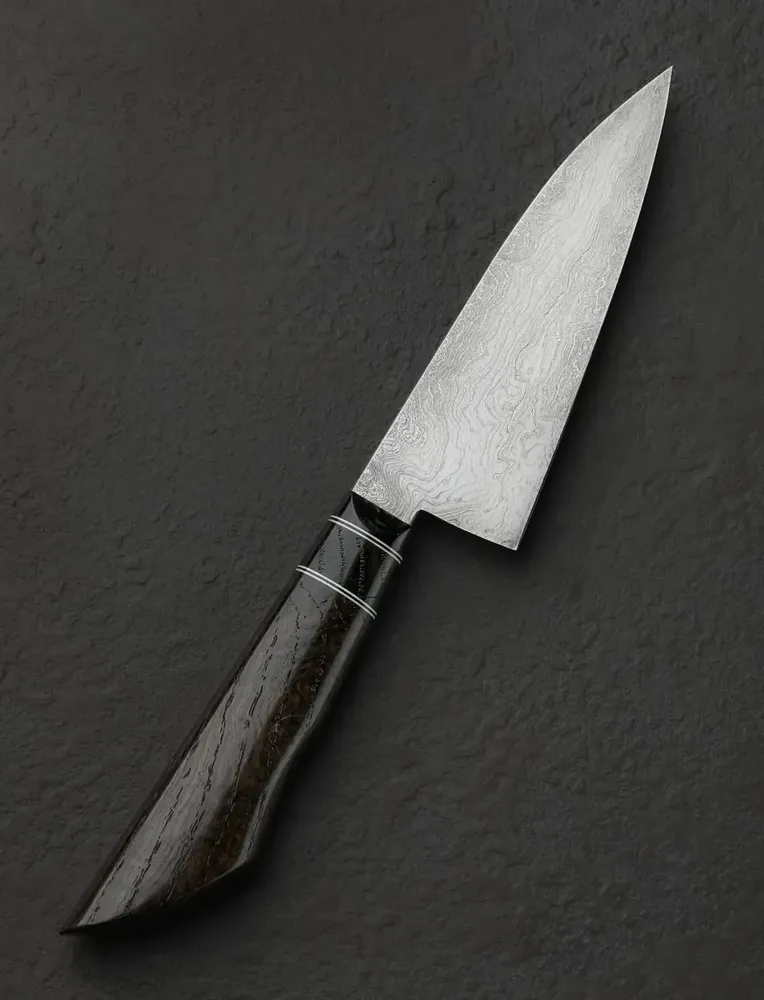
Reclaimed from a ship salvaged in the 1950s off Utö, Sweden, the rare bog oak set into this knife’s handle is believed to be pre-Viking or Viking-era timber. A friend of bladesmith Emiliano Carrillo’s father is credited with the salvaging effort nearly 70 years ago. Paired with it is a second, beautifully figured piece of bog oak sourced from a small family operation in Eastern Europe, where workers pull naturally stabilized wood directly from beneath the surface of local bogs and perform all processing to ready it for use. Completing the handle, alongside handsome black and white spacers, is a ferrule of Icelandic ram’s horn from the farm of a friend. Thoughtfully sculpted and tapered from back to front, the handle offers ergonomics to match its visual depth.
The blade is of the same caliber. Forged at his one-man shop in New Jersey, Carrillo’s 650-layer high-carbon damascus forms a 118mm / 4.6″ blade that may be the very definition of the chef’s companion. Standing 38mm at the heel, the tall profile with sharp, thin edge beneath convex bevels handles the vast majority of cuts around the kitchen. Stiff and wide at the rear, the rounded spine tapers steadily to a very fine, needle-like tip built for precise, detailed work. Like a topographic map of the world from which the iron, wood, and horn were sourced, the damascus layers are as organic in form as the oak’s own grain.
Three materials pulled from the earth, centuries apart. One knife.